Why Target Shut Down Its Creator Affiliate Program for a Gamified Creator Community
Target
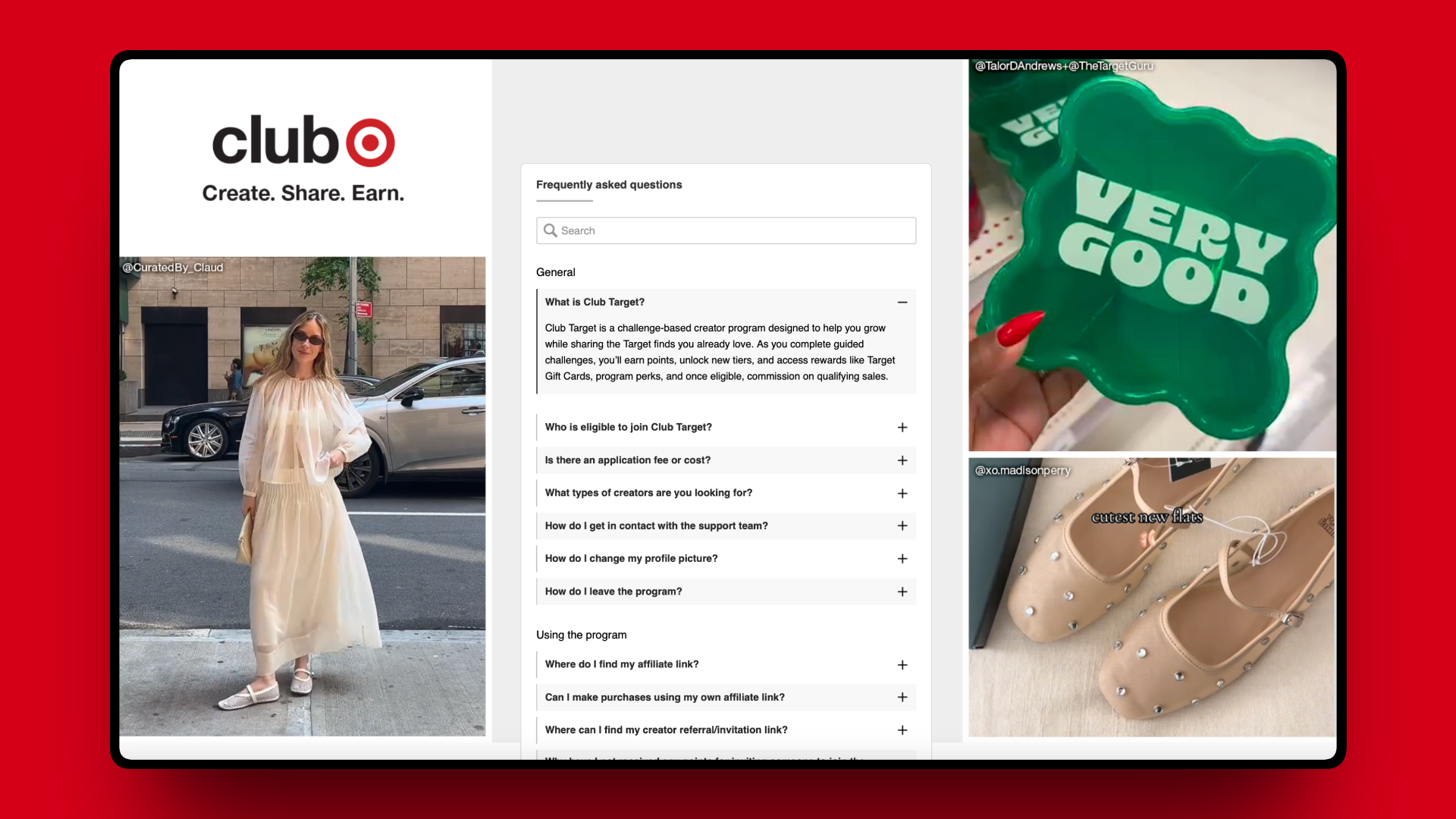
Less than three years after launch, Target is shutting down its Target Creator Program, an affiliate-based initiative that enabled creators to build storefronts, share product links, and earn commissions. The retailer is replacing it with a new program called Club Target.
The program is open to anyone with 500 or more followers. Participants progress through tiers by completing challenges, earning points, and unlocking rewards like gift cards and perks. There is still an affiliate layer, but it has to be earned. Storefronts and commissions only become available once creators unlock that tier.
Target’s move reflects a broader shift among retailers that are evolving their affiliate programs or launching new ones built around gamification and structured advocacy. This includes American Eagle Outfitters (AE Creator Community), Urban Outfitters (ME@UO Creator), Gap (Gap Creator Community), and more recently Aerie (Aerie Realmakers Community).
Affiliate remains a component of many of these programs, but at their core is always-on gamification, offering advantages that traditional affiliate models do not. Because creators are incentivized to complete specific prompts or challenges, brands have more influence over the type of content being produced and can better align it with key initiatives and priority products.
By contrast, in traditional affiliate models, creators are primarily incentivized to drive sales and will naturally optimize for conversion, which often does not align with how brands want to shape product narratives.
Retention is another advantage. In affiliate programs, creators can quickly disengage if they are not seeing results. Tiers, leaderboards, and badges change that dynamic, giving creators reasons to stay active beyond commission potential.
Scale is also a major driver. From Unilever to Bath & Body Works, more brands at the executive level are committing to creator programs involving thousands or even hundreds of thousands of creators. Running those programs through traditional means, finding, briefing, and managing creators individually, does not scale at that volume. Gamified, always-on programs are becoming one of the primary ways brands get there.
Cost is another factor. While affiliate is framed as performance-driven and efficient, commission costs can compound quickly, especially for retailers already facing margin pressure. Programs that expanded over time may no longer be as attractive as they once were, which could explain why Target structured Club Target this way, making affiliate something creators unlock rather than a default.
There is an argument that these gamified programs are not purely about advocacy given the level of brand direction involved. But more importantly, they signal the growing importance of smaller creators.
While larger creators tend to dominate headlines, smaller creators are becoming a bigger part of the influencer marketing mix. Nearly half of influencer marketing spend is expected to go toward creators with fewer than 20,000 followers this year, according to eMarketer.
Higher trust and engagement, niche audience relevance, and cost efficiency all work in their favor. So do interest-based algorithms that make follower count less important, technology that enables brands to manage creators at scale, and the rise of creator-led ad formats, where brands can put paid media behind creators’ posts to achieve the targeting, reach, and performance they want.